
What Bourbon Deeds Convey
The Bourbon County Register of Deeds is the county's recording office for real estate instruments. A deed does several things at once. It names the parties, states the form of transfer, carries the legal description, and gives a recording reference for future searches. Mortgages, assignments, releases, tax liens, mechanic's liens, oil and gas leases, easements, and plats sit in the same deed records. Not all of them transfer ownership. Check the instrument type before treating any indexed name as the owner of record.
| Deed Type | What It Does | Common Use |
|---|---|---|
| Warranty deed | Transfers the stated interest with broad covenants from the grantor | An ordinary sale |
| Quitclaim deed | Transfers only the interest the grantor may hold | Family transfers or correcting an ownership issue |
| Executor or administrator deed | Conveys estate property under probate authority | An estate sale or distribution |
| Sheriff's deed | Records a transfer following a court-directed sale | Foreclosure proceedings |
| Tax deed | Records a transfer resulting from the tax-sale process | Delinquent real estate taxes |
A mortgage or lien is an encumbrance. That means a claim or burden attached to the land, not a transfer of title. When you find one in the deed records, also look for its release or satisfaction. A deed itself may reserve minerals, grant an easement, or point to an earlier plat. The recorded image holds that detail. The index line alone does not.
Bourbon RMIS Access Since 1993
The county states that its RMIS online records reach from 1993 to the present. Remote access is not a free public index. A subscription costs $1,500 per year. The RMIS sign-in requires a username, a password, a six-digit verification code, and a CAPTCHA. No public grantor-grantee search screen exists on the other side of that gate. A free computer at the Register of Deeds is the main alternative for visitors. Remote researchers can contact the office about a specific instrument or tract. The subscriber login page itself shows the gate. It stands between the public and a direct web search. Plan around that boundary rather than assuming an online deed search will work from home. View the official Bourbon RMIS subscriber screen.
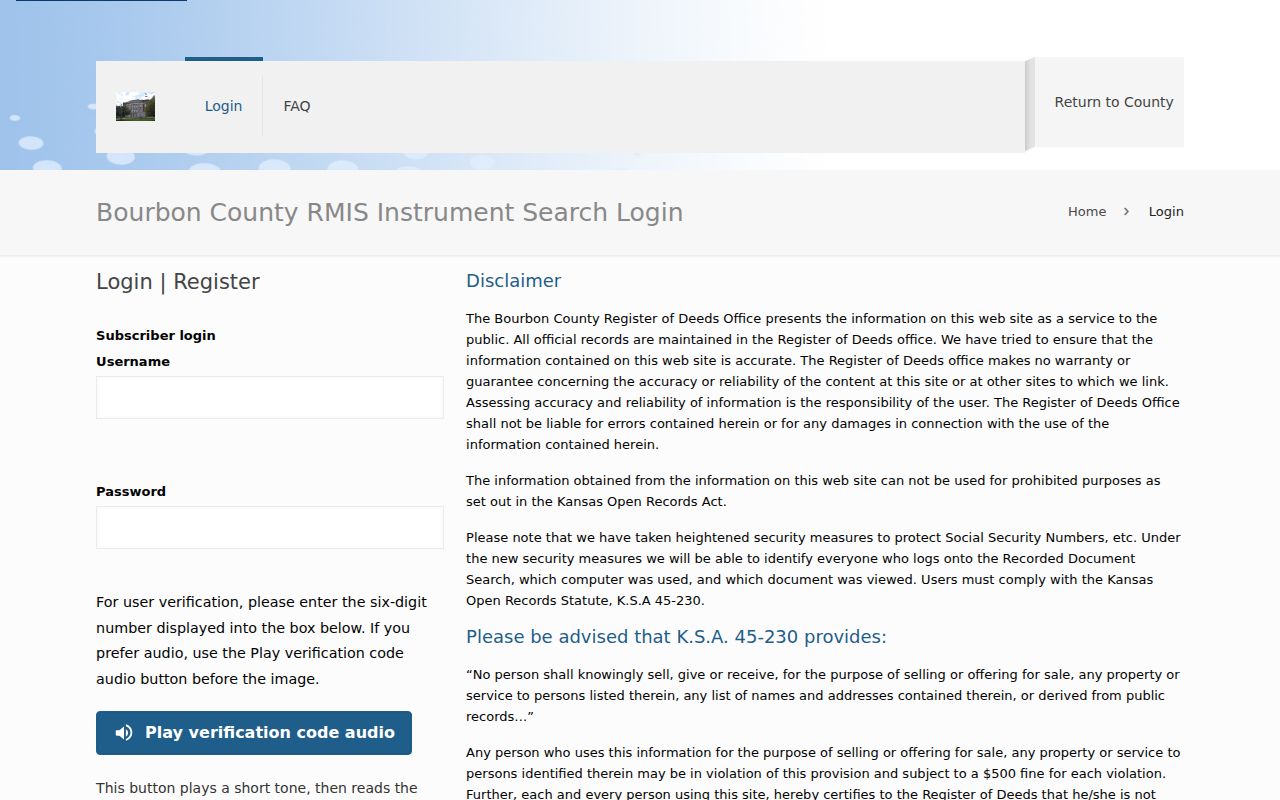
That screen is only a login, not a sample deed result. Without a subscription, an office-terminal search or a focused request to the Register of Deeds remains the practical route into the deed records. Bourbon County offers no open online index to take its place.
Note: RMIS coverage starting in 1993 does not mean every older instrument has been imaged or indexed online.
Follow Bourbon's Grantor-Grantee Chain
Bourbon County deed records are indexed by the people giving and receiving each interest. Begin with the current vesting deed. Then work backward one transfer at a time. An address is only a clue, because recorded legal descriptions may use a lot and block, an addition name, or section, township, and range. The Bourbon County property search can supply the parcel number and current owner of record before you start the name search. That groundwork saves time in the grantor-grantee index.
- Find the current acquisition deed with the present owner shown as grantee. Confirm the legal description against the parcel.
- Read the grantor, recording date, deed type, and book/page or instrument reference from that deed.
- Search the grantor as a grantee in an earlier period. Open the earlier instrument and verify the same land description.
- Repeat until the chain reaches the online cutoff, then shift to deed books, microfilm, plats, and archive finding aids.
- Grantor
- The party conveying the stated interest.
- Grantee
- The party receiving that interest.
- Chain of title
- The linked sequence of instruments affecting the same land.
- Book/page
- A reference to a bound or imaged recording volume and page.
- Instrument number
- A unique identifier assigned when a document is recorded.
Names alone can mislead. Check middle initials, entity spellings, married names, estate representatives, and trust wording at every step. Each deed in the chain must match the same legal land, not merely a similar street address.
Email a Bourbon Tract Request
The Register of Deeds publishes unusually concrete email-research guidance. A tract-index request can cover up to 50 years per section. Expect roughly 10 to 12 pages per email. The base fee is $16, with possible extra charges for research or document copies. Give the office the section, the legal description, and owner names. Specify the exact date range you need. A focused request beats asking for everything tied to an address.
Rural parcels need section, township, and range. Fort Scott land needs the addition, block, and lot when known. Ask for existing index entries plus the identified instrument copies. The office records documents. It does not prepare a legal opinion on which instrument controls.
Note: Confirm the final amount with the Register of Deeds before sending payment. Confirm the delivery method too.
Bourbon Deeds on Historic Microfilm
The Kansas Historical Society collection holds Bourbon County deed microfilm spanning 1856B through 1900. The collection runs 34 rolls. Direct and reverse indexes are included. The volume letters are not a straight alphabetic run. The catalog itself notes volume K with no J, so a missing letter is not evidence of records loss without an archive statement.
Microfilm builds a documented bridge into early Bourbon County deed records, but it does not close every gap. No complete archive run covers 1901 through 1992. Ask the Register of Deeds which original books, images, or local films hold the year you need. The Historical Society also describes Kansas land records and maps, including federal tract books and county land material. Open the official Bourbon deed-microfilm catalog record.
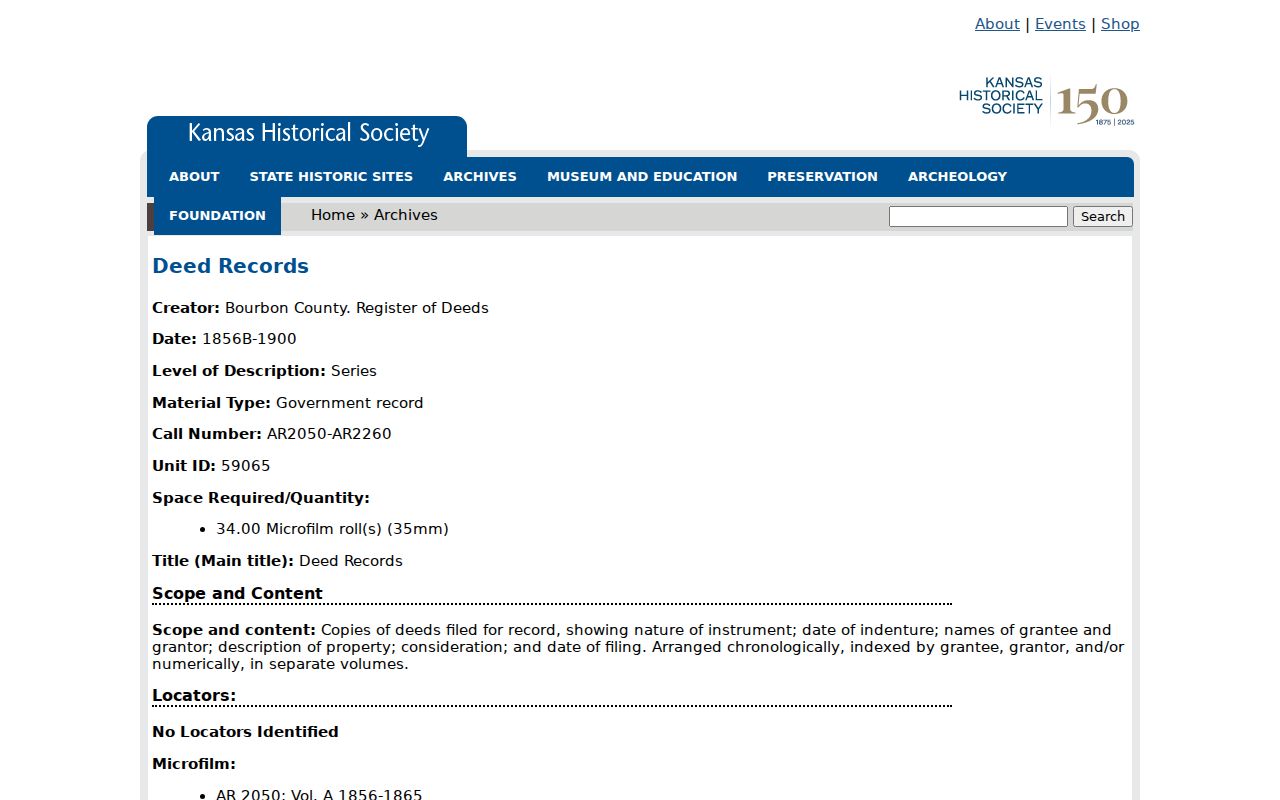
The catalog entry is a finding aid. It identifies the series and roll for an archive request, but it does not prove a named owner of record appears on any specific roll.
Records Moved for Safety
Bourbon County moved its seat to Marmaton in 1858 to keep records safer. It brought them back to Fort Scott in 1863. That early shuffle matters for anyone tracing land or court files from the 1850s and 1860s. A deed dated between 1855 and 1863 might have been recorded at the temporary seat. Ask whether that series stayed there. Ask also whether a local or state archive holds a finding aid for it.
The move does not mean records were lost. Treat it as a custody clue. Match the instrument date against the deed-book designation, both the direct and reverse index, and the archive catalog. An index pointing to a missing volume deserves a series-level explanation from the archive. That explanation should come from the archive, not an assumption of courthouse loss.
Additions Shape Fort Scott Deeds
Fort Scott deeds and public notices lean on named additions. These include Cameron's Addition, Oak Hill Addition, J.W. McMillan's Addition, Pratel Addition, South Side Park Addition, and Durkee & Stout's Addition. An "addition" here is part of a platted legal description, not a casual neighborhood label. A 2021 city agenda tied an alley vacation to Pratel Addition. A 2026 agenda weighed street and alley vacations in Durkee & Stout's Addition. Plats drive these descriptions, and they shift over time.
When you search Bourbon County property records for city land, keep the exact addition, block, and lot together. Replats, street vacations, and alley actions can change access. They can also alter the description in later deeds. City agendas are leads only. They do not prove a final ordinance passed or was recorded. Confirm the outcome with the city, then verify the recorded document with the county recorder.
Note: A recorded plat and a deed legal description beat an informal neighborhood name as search keys.
Get a Bourbon Deed Copy
Take the index reference you found and request the deed itself from the Register of Deeds. There are several ways to do it. The paid RMIS system works remotely, while the free courthouse computer is an option on site. An email tract-index request, a phone call, or a letter also works. The office sits at 210 S National Avenue, Suite 14, Fort Scott, Kansas 66701, and the phone is 620-223-3800 extension 106. Before ordering, ask whether a plain copy or a certified copy suits your purpose, and get the current copying and certification charge.
Remember that the index entry only points the way. The deed image holds the real detail. Read it for signatures, acknowledgments, reservations, easements, and the full legal description. For deeds recorded before 1993, give the office the year range and ask which book, microfilm, or archive path applies. Save the response and the recording reference with your notes so the same instrument can be located again later.
Review the official Register of Deeds office page and its current request guidance.
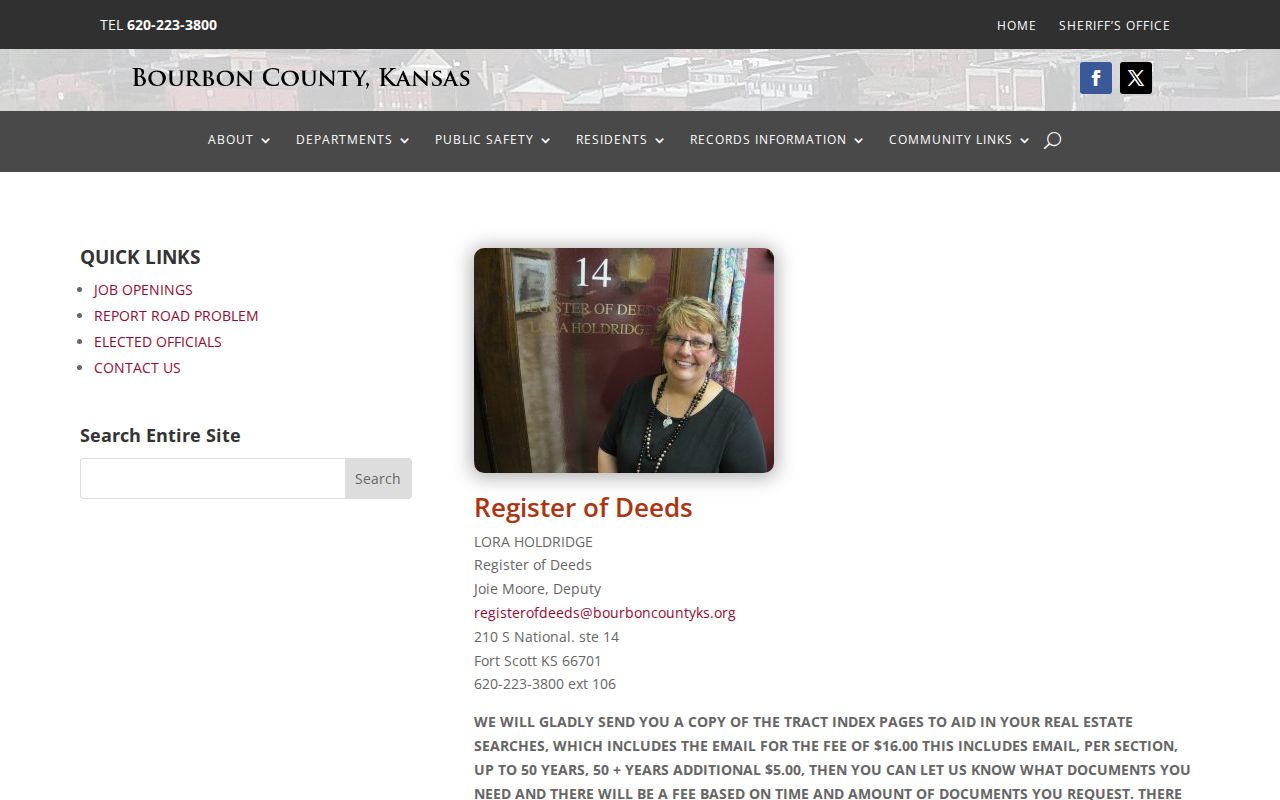
The official Register of Deeds page lists the custodian, contact routes, tract-research terms, and current fees. Checking it first keeps a copy request on track.
Recorded, not guaranteed. Bourbon County deed records show instruments accepted for recording. They do not resolve unrecorded interests or provide a title opinion.
A purchase, boundary dispute, or easement question may call for a title professional or attorney. The county office supplies the public record. It does not decide legal ownership.