
Find Out Who Owns a Bourbon County Property
A solid answer to who owns a Bourbon County property leans on three sources. These come in a fixed order. First, the tax or CAMA system finds the parcel. It also offers an owner-of-record clue. Next, the Register of Deeds index shows the grantee named on the newest recorded deed. ORKA then helps you confirm the legal description matches the tract you meant. Treat no single screen as final. The tax, appraisal, map, and deed systems all refresh on different schedules.
- Search the street address in the Bourbon tax portal and copy its CAMA, parcel, and legal-description keys.
- Note whether the displayed name is labeled Current Owner, Taxpayer, or Both.
- Search the legal description and name in the Register of Deeds route, then identify the latest deed and its grantee.
- If the grantee is an LLC or corporation, cross-check the exact entity in the Kansas Secretary of State system.
A result without a legal description is not ready to confirm. Similar street names, address changes, vacant lots, rural tracts, and split parcels can all produce a plausible but wrong match. Save the date and label from every source you check.
Bourbon County Separates Owner From Taxpayer
The Bourbon County tax search lets you pick a Name Match Type of Current Owner, Taxpayer, or Both. That flexibility makes it a great parcel locator, but it also hides a trap. A taxpayer may pay the bill without holding title. The current-owner field can lag behind a newly recorded deed.
You can also search the portal by CAMA number, Owner ID, Tax Unit/Parcel, address, subdivision/block/lot, or section/township/range. Pull up candidates by owner name. Then compare the parcel key and full legal location before trusting a match. The general Bourbon County property search walks through those search modes in more depth.
Open the official Bourbon tax criteria page to see the options yourself.
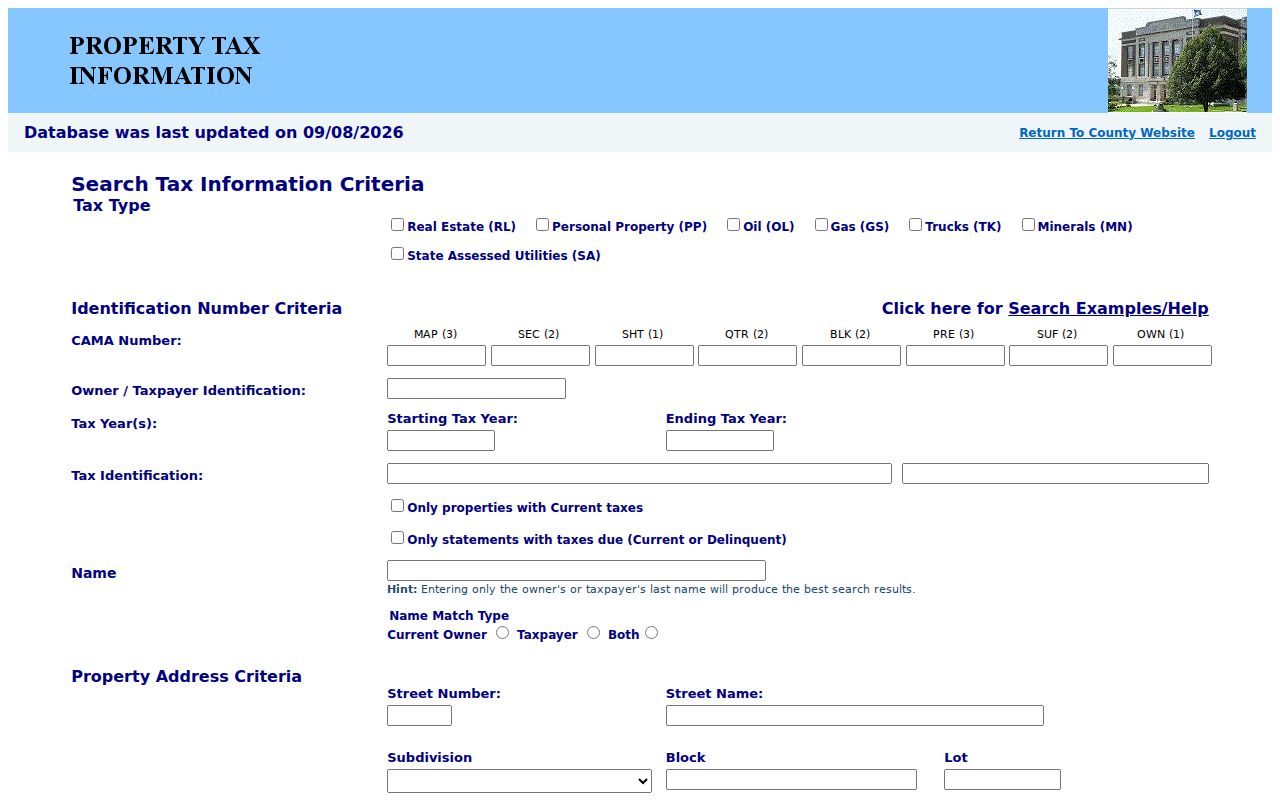
The criteria page lists search fields only, not ownership. A named result still needs the newest deed and a matching legal description.
Trace the Bourbon County Name to the Latest Deed
The Bourbon County Register of Deeds records deeds and every other instrument affecting real property. Each one gets a timestamp and a book/page reference. The county indexes legal descriptions on the next business day. That recorded trail is your confirmation step. It kicks in once the tax or CAMA locator hands you a likely owner.
RMIS, a subscriber index, covers county records from 1993 to the present. Online access runs $1,500 per year. A public computer inside the Register of Deeds office is free. Visitors can go to 210 S National Ave, Suite 14, Fort Scott, call 620-223-3800 ext. 106, or request tract-index research by email. The $16 tract-index service covers one section and up to 50 years. Stated fees apply for longer coverage or document work.
Note: An index hit identifies a recorded instrument; it does not make the county a title examiner or guarantee that no unrecorded interests exist.
Compare Bourbon County Ownership Sources
Each official source answers a narrower question. Tax and appraisal systems attach names to an assessed parcel. The deed index records conveyances by parties and legal description. GIS locates mapped geometry. The Secretary of State identifies a filed business entity when one appears as grantee. Together they explain who owns a tract. A map label or mailing address alone does not prove title.
| Where ownership is shown | What it gives | How current |
|---|---|---|
| Tax and CAMA systems | Parcel locator, Current Owner or Taxpayer label, valuation context | System-specific update; may trail a deed |
| Register of Deeds index | Newest recorded deed, grantee, timestamp, book/page | County says legal-description indexing occurs next business day |
| ORKA | Mapped parcel geometry and available property attributes | Parcel data reported 2026-08-13; not title |
| Kansas entity search | Exact LLC or corporation, business ID, resident-agent route | Entity filing record, not proof of individual ownership |
The owner of record is the person or entity tied to an official ownership or assessment record. A grantee is the recipient named in a deed. The situs address locates the land itself, while a mailing address handles correspondence and may sit anywhere. None of these labels tells you who occupies the property. Keep each term attached to its own source.
View the Bourbon County KSCAMA access screen to see the entry point for parcel records.
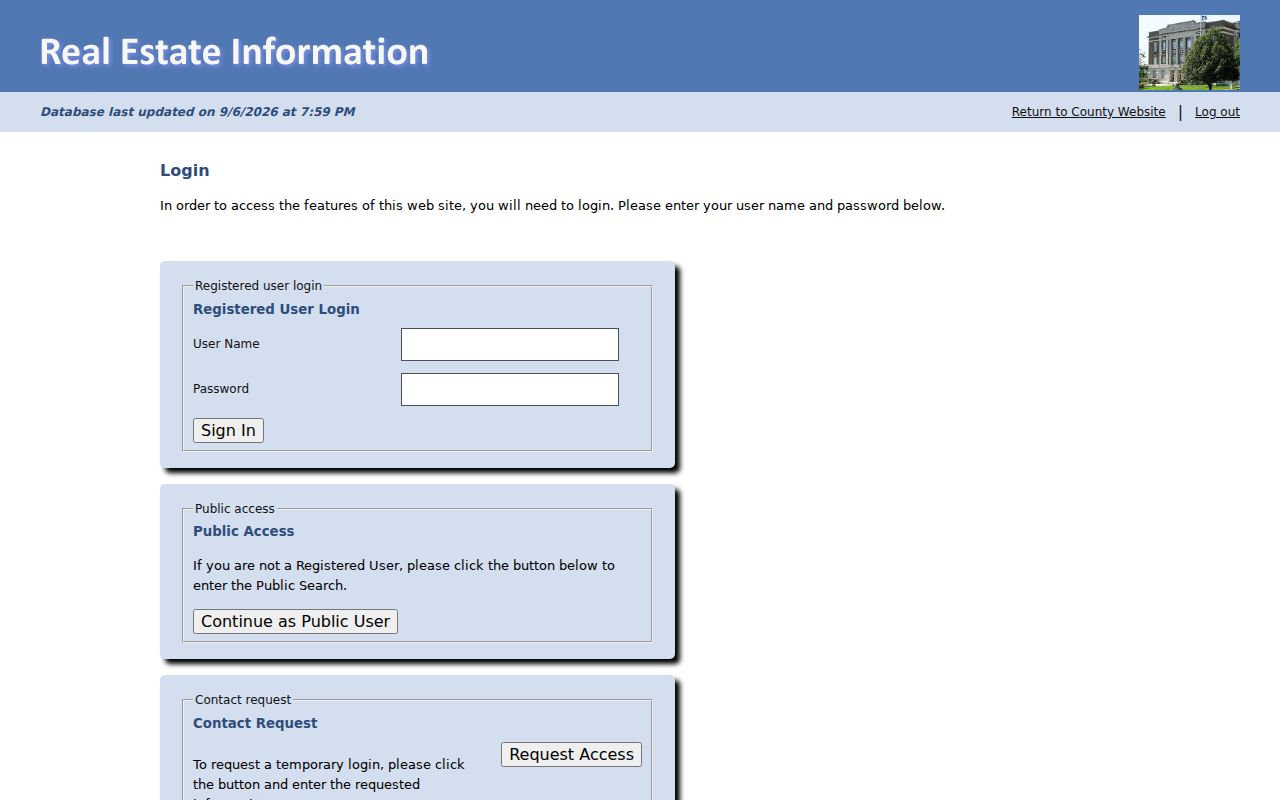
That KSCAMA page offers a Continue as Public User route plus registered access controls. It does not itself display a parcel card or prove who owns a selected property.
Identify a Bourbon County LLC Owner
When the newest grantee is a corporation or LLC, use the exact name. Run it through the Kansas Secretary of State Business Entity Search. The portal accepts a business name, a Kansas SOS Business ID, or a current resident-agent name. Business-name matching supports Contains or Starts With. The ID search takes digits only. No spaces or dashes are allowed. It returns at most the first 200 matches.
The entity record can tie the deed name to a business ID. It also lists a registered agent and a filing history. It will not reveal every person behind an entity. A negative result does not prove a business is fictitious either. Sole proprietors and general partnerships may never file with the Secretary of State. A trust calls for the deed and the related estate or trust instruments. Guesswork from a surname will not do.
Bourbon County Owner Records Update at Different Times
The county's owner records refresh on separate clocks. Each portal posts its own update stamp. The tax database, KSCAMA, and the two ORKA data sets rarely agree on the same date. The deed office works differently. It relies on its recording timestamp plus next-business-day indexing of legal descriptions. So a newer date on one portal means little on its own.
| If sources conflict | Next check |
|---|---|
| Tax owner differs from grantee | Use the newest recorded deed and ask Appraiser when the roll will reflect it |
| Map identifier differs from tax account | Compare both dates and ask GIS about a split, combination, or correction |
| Address produces the wrong parcel | Switch to lot/block/addition or section/township/range |
| Public result omits sales | Recognize that county Level 3 access includes sales; omission may be access-limited |
A later portal date does not outweigh a recorded deed on title. It only shows when that particular database reported an update.
Old Bourbon County Addresses Need Parcel Clues
A Kansas Historic Resources Inventory entry for Western Insurance Company shows how tangled old Bourbon County addresses can get. One record ties current address 100 S Main to historic addresses 100-108 S Main and 14 E1. The same entry lists parcel address 8 E1, parcel ID 119-30-0-30-03-001.00-0, and Lots 2 and 4 in Block 102. Search by street alone and you may miss the link entirely.
Keep every address form when you dig into older or changed properties. Then search the parcel number and the legal description. City property in Bourbon County may sit in named additions like Cameron's, Oak Hill, Pratel, or Durkee & Stout's. Rural land may require section, township, range, quarter, acreage, and metes-and-bounds language. That is why the owner-finding method ends with legal evidence rather than a name alone.
Request a Missing Bourbon County Owner Field
When the public portal leaves out a field you need, be specific. Ask for the existing record itself. List the street address, parcel or CAMA number, and tax-unit reference. Add the legal description. Include the Current Owner and Taxpayer labels. Also give the date of the most recent roll update. For a deed search, give the legal description and a year range. Do not ask the office to build an ownership history for you.
The Bourbon County KORA page routes requests through the County Clerk at 620-223-3800 ext. 100. A written request is recommended but not required. Under KORA, the agency must act by the end of the third business day. It can produce records, deny access, or explain a delay. It need not create a record or answer a research question.
Note: Ask for inspection first when copy costs may matter, and keep the office response, fee estimate, and any redaction explanation.
Know the Limits of a Bourbon County Owner Lookup
A name on the tax roll answers less than people assume. It does not identify who occupies the address. It does not prove every interest has been found, and it cannot resolve a dispute. Ownership may rest in an LLC, corporation, trust, estate, or multiple grantees. Easements, liens, mineral interests, probate orders, and unrecorded claims can complicate the picture further. A property records search supports due diligence. It never replaces professional title work.
Privacy rules also shape what Bourbon County records can reveal. Kansas Safe at Home gives eligible participants a substitute legal address with mail forwarding. That protected address can appear in public city, county, voter, court, and law-enforcement records. Never try to reverse a substitute address. ORKA and RMIS likewise restrict name-and-address lists used to solicit property offers. Services fall under that limit too. In short, the rules bar using those lists to pitch offers or services.
The public record can back a contact or due-diligence trail. It cannot establish who was physically present at an address on a given day. Keep the inquiry tied to the land and its recorded interests.
Lawful use. Use Bourbon County owner records for legitimate property research, boundary questions, estate work, or purchase diligence, never to stalk, harass, or harm a person.