
Read Bourbon County Property Tax Records
Two connected systems hold Bourbon County property tax records. The Appraiser's office builds parcel classifications and values. The Treasurer's CIC Tax Search handles account lookups, tax years, and current or delinquent filters. Keeping those roles straight matters. The appraised value is the county's fair-market estimate. The assessed value is the tax base after the Kansas class rate applies. The tax account shows the bill and its status. Neither a taxpayer label nor payment history proves title, so treat them as billing clues rather than ownership proof.
| Field | What It Shows | Where |
|---|---|---|
| Appraised value | County estimate of fair-market value for valuation purposes | Bourbon County Appraiser |
| Assessed value | Appraised value multiplied by the applicable Kansas property-class rate | Appraiser and certified tax roll |
| Classification | Actual-use class applied as of January 1 | Appraiser |
| Tax year and status | Year filter plus current-tax or taxes-due selection | CIC Tax Search |
| Owner or taxpayer | Separate name-match choices for Current Owner, Taxpayer, or Both | CIC Tax Search |
Kansas assesses residential real property at 11.5% of appraised value. A Department of Revenue teaching example makes the math plain. $100,000 appraised becomes $11,500 assessed. That figure sets the tax base, not a likely sale price. Other classes run higher. Commercial and industrial property carries a 25% rate. Vacant lots and eligible nonprofit real property sit at 12%. Agricultural and other real property uses 30%. Public utility property uses 33%. Classification follows actual use, not just the zoning label on the parcel.
Search Bourbon County Taxes Seven Ways
The Bourbon County CIC Tax Search bends further than most county tools. It accepts identifiers, names, street details, subdivision references, and rural legal locations. Always choose the most stable key. An exact CAMA or tax-unit/parcel identifier beats a loose name. Some properties have no dependable street address. Subdivision, block, and lot or section, township, and range can still rescue the search.
| Search route | Visible inputs | Best use |
|---|---|---|
| CAMA | MAP, SEC, SHT, QTR, BLK, PRE, SUF, OWN segments | Direct account lookup |
| Owner ID | Owner/Taxpayer Identification | Known account holder |
| Name | Name plus Current Owner, Taxpayer, or Both | Separate title and billing clues |
| Address | Number, street, direction, ZIP | Improved property with a situs address |
| Subdivision | Subdivision, block, lot | Platted town property |
| Rural location | Section, township, range | Acreage and rural tracts |
| Tax period | Starting year, ending year, current taxes, taxes due | Separate current status from history |
The tax-type menu reaches beyond land. It covers real estate, personal property, oil, gas, trucks, minerals, and state-assessed utilities. Choose real estate for land and improvements. Use a separate mineral or other account only if the record points to one.
The official search screen lays out the Bourbon County property tax fields in context.
Open the Bourbon County tax-search criteria page before comparing the field groups.
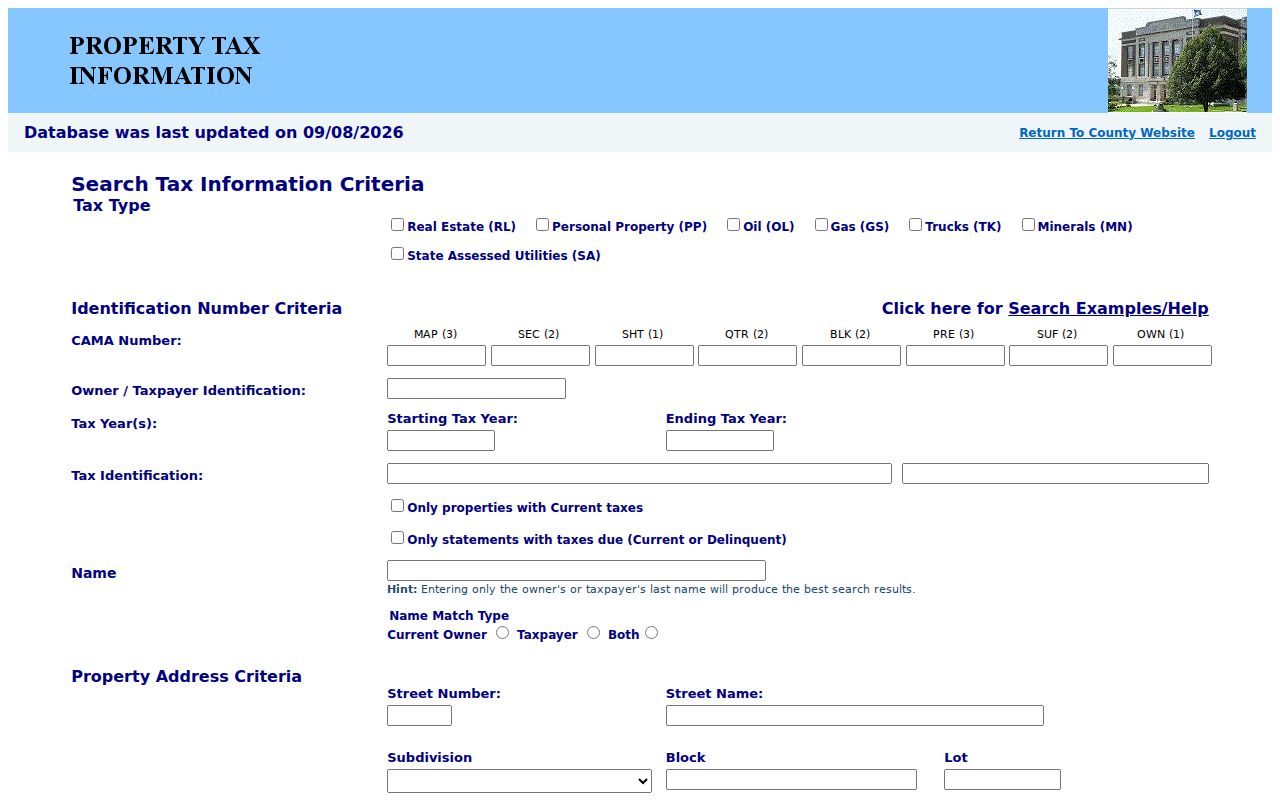
That official screen is a criteria page, not a sample bill. It maps the available search routes but establishes no balance, payment, delinquency, or parcel value.
Bourbon County Owner and Taxpayer Labels Differ
The portal's Current Owner, Taxpayer, and Both choice is not cosmetic. The current-owner label is a tax-system ownership clue. The taxpayer is whoever the billing side names. Those names can differ. Neither one substitutes for the grantee on the newest recorded deed. When a name search lands on a likely account, save its CAMA number, tax-unit/parcel reference, legal description, and tax year. And save the label attached to the name.
For a title question, carry the legal description to the Bourbon County deed records. For a billing question, stay in the tax account. Contact the Treasurer when a statement or transaction is not visible. Keeping these paths separate stops a paid bill from being mistaken for proof of ownership.
Note: The Treasurer's portal shows search criteria rather than a live statement, so verify any balance with the office.
Look Up a Bourbon County Tax Bill
Start in the Treasurer search. Use it when the goal is a Bourbon County property tax bill or tax-year history. The page accepts a broad address search. A CAMA number or tax-unit/parcel reference cuts false matches sharply. Keep the result's as-of date too. The tax database, appraiser data, GIS, and deed index refresh on separate schedules.
- Select Real Estate, then search by address, CAMA number, or tax-unit/parcel identifier.
- Set starting and ending tax years, and distinguish current taxes from statements with taxes due.
- Record owner and taxpayer labels without assuming either is the latest deed grantee.
- Compare valuation details through the Appraiser and ask the Treasurer for any statement detail the public result does not expose.
- Assessed value
- The appraised value after the Kansas class rate is applied; it forms the tax base.
- Levy
- The taxing charge applied to assessed value by the relevant jurisdictions.
- Classification
- The Kansas category based on actual property use as of January 1.
- Tax lien
- A recorded or statutory claim tied to unpaid tax, which requires separate status verification.
The 2026 Bourbon County Market Study
The Bourbon County Appraiser published a 2026 market study under K.S.A. 79-1460a. Residential property shows an annual inflationary trend of 6.92%. Commercial property trends at 4.97%. Vacant lots held stable. Those are countywide trends, not automatic increases on every parcel.
The Appraiser cautions that an individual parcel can move differently. Property changes, corrections, and comparable-sales adjustments drive that. Pull the individual valuation record and notice. Skip the shortcut of applying the county percentage to an old value. KSCAMA public access is limited. County guidance says Level 2 excludes sales and Level 3 includes them.
Open the Bourbon County KSCAMA access screen to view the access choices.
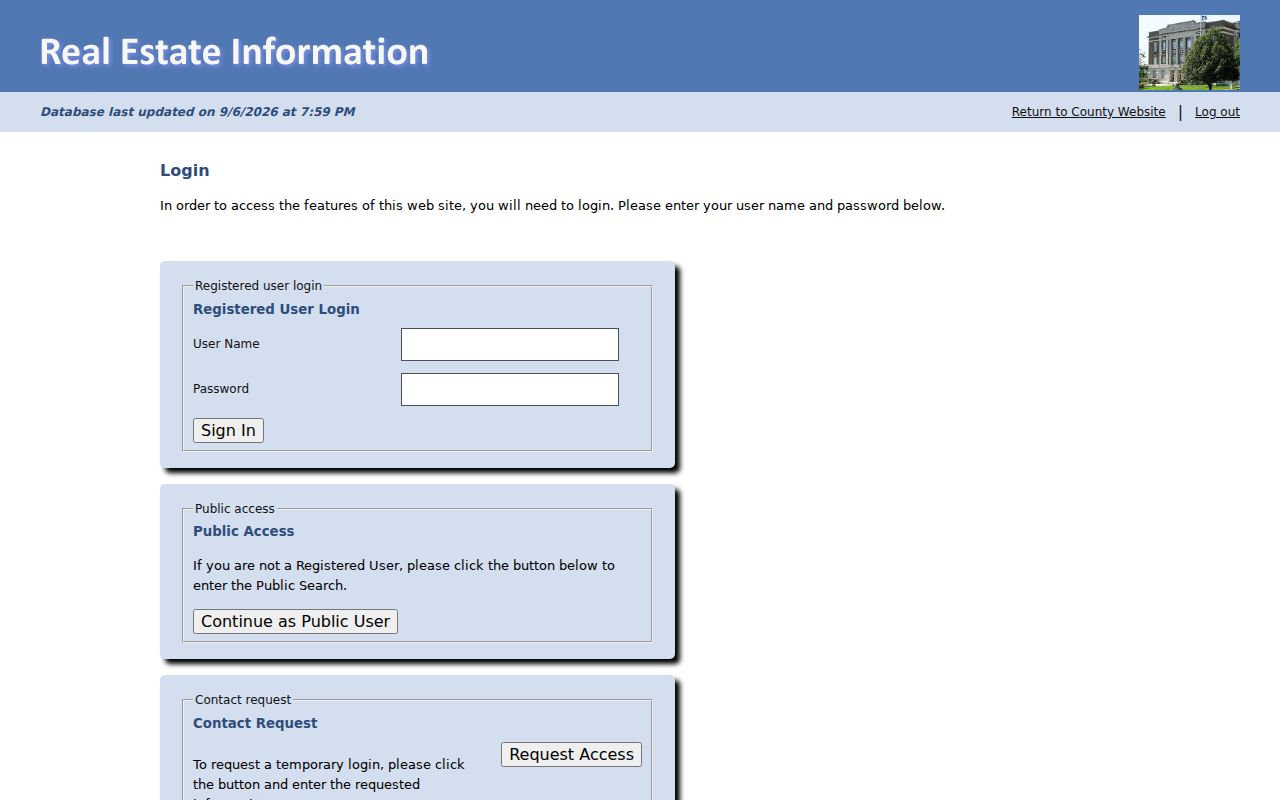
The login page presents public-user and account-access choices, not a live parcel value or sale. Request the individual record before making any parcel-specific claim.
County trend, not parcel result. The 2026 percentages describe market study trends; only the individual Bourbon County value record supports a parcel-specific claim.
Compare Bourbon County System Dates
A fresh property tax search can still clash with another official system. The tax database banner carries a 09/08/2026 date. KSCAMA lists 09/06/2026 at 7:59 p.m. ORKA reports parcel data dated 08/13/2026 and CRS data dated 08/31/2026. Each timestamp belongs only to its own source.
| System | Observed date | What to preserve |
|---|---|---|
| CIC tax database | 09/08/2026 | Tax-year and account status date |
| KSCAMA | 09/06/2026 7:59 p.m. | Valuation-system update banner |
| ORKA parcel | 08/13/2026 | Map parcel-data date |
| ORKA CRS | 08/31/2026 | Separate property-data date |
When records conflict, keep the identifier and timestamp from each. Ask the Appraiser about classification or value. Ask the Treasurer about the tax account. Ask the Register of Deeds about the recorded ownership instrument.
Request Missing Bourbon County Tax Detail
A portal is just one way in. The Bourbon County Clerk certifies the real-estate, personal-property, and state-assessed tax rolls to the Treasurer. Special assessments go along too. For value questions, the Appraiser handles the CAMA figure and classification. When a record sits outside the online search, a precise written request works best. Name the address, the CAMA or parcel number, the legal description, and the tax years. Then list the exact fields you want pulled from the property records.
Kansas Open Records Act requests can move through the county open-records route. Bourbon County prefers writing but never demands it. KORA gives the agency until the end of the third business day to grant access. It can also deny the request or explain a delay. The law does not require an office to build a new calculation on demand. A research report is not required either.
Note: Ask to inspect an existing roll or tax bill first when copying costs matter. Also keep any estimate or redaction explanation.
Cross-Check Bourbon County Tax Liens and Court Files
A taxes-due flag is a lead, not a file. It hints at distress but proves nothing alone. A purchase, estate, or title question can turn on the answer. Then set the tax account beside recorded liens and any court case. The Register of Deeds holds tax liens and other instruments that affect real property. The deed records are the natural first stop. Bourbon County also sits in Kansas's Sixth Judicial District. Foreclosure, quiet-title, partition, and related civil filings land there.
Begin with the Sixth Judicial District records page. Then move to the Kansas Public Access Portal if the case is available there. A party name or case number works as a search term. Record the case type, the parties, the judge, and hearing dates. Note any document-access limits you hit. One caution matters. A case party is not always the owner of record. A filed petition is not a judgment.
To trace a foreclosure, line up three things. Match the petition or docket against the recorded lis pendens. Then match it against the final decree or sheriff-sale papers. The Register of Deeds schedule lists lis pendens filings under K.S.A. 60-2201, which shows why the deed-index side of the property records matters. Older court files may sit offline entirely. For those, contact the district court clerk for the correct request route. Sealed and protected files stay outside public access.
Challenge a Bourbon County Assessment
Kansas draws a clean line between two fights. An appraisal appeal questions the value; a payment dispute questions the tax bill itself. A change-of-value notice arrives. The owner then has 30 days to appeal to the county appraiser. Build a parcel-specific packet. Include the notice, property characteristics, and photographs of condition. Add correction evidence, comparable sales when available, and the record date. The Kansas Property Valuation Division also walks through payment-under-protest procedures. That covers the tax stage of the property records.
For the local review route, contact Matt Quick's Bourbon County Appraiser office. It sits at 210 S National, Fort Scott, 620-223-3800 ext. 805. Suppose KSCAMA does not display the fields you need. KDOR's PVD-75 form then offers a KORA request path to existing CAMA records. The form wants a requester. It also wants a specific description of the records, not a fresh appraisal.
Appeal window. File with the county appraiser within 30 days of the change-of-value notice; preserve the notice date and parcel evidence.